 French
 English


Multi-frequency nonlinear surface acoustic waves for depth-resolved characterization of concrete and steel
Pierric MORA
Chargé de recherche au GERS-GeoEND, Univ Gustave Eiffel, Bouguenais, CS5004, F-44344, France
Le 17 Septembre 2026 à 13h30, Amphi PINEL
Abstract:
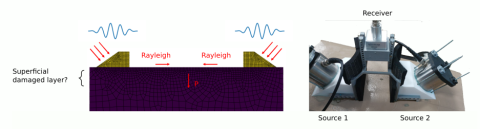
In a number of cases in civil engineering the surface of a material is where damage initiates: corrosion, heat induced micro-cracking or carbon depletion for steel, ingress of chemicals in concrete causing carbonation or external sulfate reaction, among many others. Assessing gradients of physical properties is fundamental to detect problems before they become critical and decide upon repair actions, and doing it non-destructively is sometimes still a challenge. In this talk I will present ongoing efforts [1] to develop two methods for evaluating surface gradients of nonlinear mechanical properties in materials, aimed at being applied on concrete and steel. Nonlinear ultrasonics has demonstrated sensitivity to micro-structural changes that can be difficult to detect with classical ultrasounds or other physical methods but has not been used yet to measure the depth extent of a shallow damage. Here, we propose to use two harmonics generation effects for surface (Rayleigh) waves to address this question, namely the second harmonics effect [2, 3], and the wave mixing [3, 4] effect that generates a P bulk wave from two counter propagative Rayleigh waves. In either case the frequency is used as a parameter to control the depth of investigation. I’ll show with numerical examples and with experiments performed on samples damaged in a controlled manner that these effects are promising candidates to achieve this goal.
References
[1] M. Fengal (2025), Evaluation of gradients of nonlinear mechanical properties using ultrasounds: Application to thermally damaged concrete (Doctoral dissertation, Université Gustave Eiffel). doi :10.70675/68aefc59zf78cz4995zb9a3z7fbf8696b0aa
[2] P. Mora, M. Spies (2018), Rayleigh wave harmonic generation in materials with depth-dependent non-linear properties, The Journal of the Acoustical Society of America, 143(5), 2678-2684.
[3] M. Fengal, P. Mora, P. Shokouhi, C. Herbin, O. Abraham, Rayleigh wave second harmonic generation and mixing for depth-profiling of acoustic nonlinearity in thermally damaged steel, under review
[4] M. Fengal, P. Mora, P. Shokouhi, E. Rayssac, E. Gennesseaux, O. Abraham, Multi-frequency nonlinear Rayleigh wave mixing in highly dissipative and scattering media, under review
Biography:
Pierric Mora obtained a PhD on mechanical guided wave propagation modeling in 2015 from the University of Bordeaux. After several years of post-docs in IUSTI (Aix Marseille Univ), Fraunhofer IZFP (Saarbrücken, Germany) and LAUM (Le Mans Univ), he joined the GeoEND lab (Univ Eiffel) in 2021. His research centers on non-destructive evaluation of civil engineering materials using nonlinear ultrasounds.