 French
 English


Continuum modelling and control of active fluids
Tullio Traverso
Research project leader, Saint-Gobain Research, Paris
Le 17 décembre 2025 à 13h30, Amphi A
Abstract:
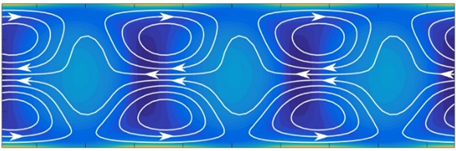
Similarly to their biological counterparts, suspensions of chemically active autophoretic swimmers exhibit a non-trivial dynamics involving self-organisation processes as a result of inter-particle interactions. In this talk we will introduce a continuum, mean-field framework to model such suspensions. This consists of a set of nonlinearly coupled PDEs that describe (i) the particle distribution (in terms of position and orientation), (ii) the fluid flow, and (iii) the concentration of a chemical species. Via linear stability analysis and by numerically solving this model, I will show the effect of a confined pressure-driven flow on these collective behaviours and the impact of chemotactic aggregation on the effective viscosity of the active fluid. Specifically, we observe four dynamic regimes, each resulting from the competition of flow- and chemically induced reorientation of the swimmers, together with the constraints of confinement.
The second part of the seminar will explore a variety of different data-driven methods that can be used to calibrate the above-mentioned models and use them for discovering optimal control strategies. Specifically, we will discuss recent developments in surrogate modelling by Gaussian process regressions, as well the use of autoencoders for model-based optimization in high dimensional design or control spaces. Applications span from active separation and filtration of microparticles, polymer extrusion, biomedical applications, and symbiotic systems.
Biography:
I am a mechanical engineer specializing in theoretical and numerical modelling of (re)active fluids, data assimilation, and machine learning to solve complex industrial challenges. Curiosity drives me to constantly learn and explore new areas of science. One of my ambitions as a researcher is to help bridge the gap between academic research and real-world applications.
During my Master's thesis, I worked on adjoint-based data assimilation using physics-constrained optimization algorithms, laying the foundation for my interest in combining data-driven approaches with physical modelling. Later, during my PhD, I focused on analytically deriving reduced models and numerically solving partial differential equations to understand the collective behaviour of suspensions of synthetic micro swimmers. This work provided me with a solid background in tackling complex physical systems using both theoretical and computational methods, including the tools of statistical physics and applied math. Following my PhD, I worked at the Alan Turing Institute, where I focused on Bayesian ML, uncertainty quantification, and numerical simulations. This included building a custom Gaussian Process Regression library to address specific needs of our industrial partners. Currently, I am a research project leader at Saint-Gobain Research Paris. My work focuses on modelling industrial processes involving the melting and flowing of glass at high temperature in industrial furnaces. These models are used to optimize the control and design of the processes themselves.