 French
 English


Integrated Structural Health Monitoring with Real-time Data Assimilation and Hybrid Twins
Ludovic Chamoin
Full Professor, LMPS, ENS Paris-Saclay
Le 08 décembre 2026 à 13h30, Amphi Esquillan
Abstract:
The design of smart autonomous mechanical structures able to perform online monitoring of their own integrity, and take anticipated actions during service before downtime of failure occur, has become an active research area. It is a critical need across various industrial sectors (transport, energy, etc.) for more reliability but also more performance and durability of equipment. Implementing such an advanced technology would permit optimized maintenance and capability to operate in degraded mode, managing the decrease of loading capabilities by adapting the operating plan.
However, the real-time damage monitoring in engineering systems, by dynamically coupling predictive simulation tools (in terms of digital twins) and sensor observations, faces several practical challenges. In particular, the complex nonlinear multiscale phenomena which are involved may be associated with computationally intensive simulations (hardly compatible with real-time), which requires reduced order modeling and effective strategies for data assimilation and control. Furthermore, robustness against modeling biases, measurement noise, and various uncertainties is essential for ensuring accurate diagnosis and prognosis, and thus safe decision-making. In this context, an appealing trend is to refer to hybrid twins, in which an a priori physics-guided model is updated and enriched on-the-fly with data-based information, thus making benefit of all knowledge available.
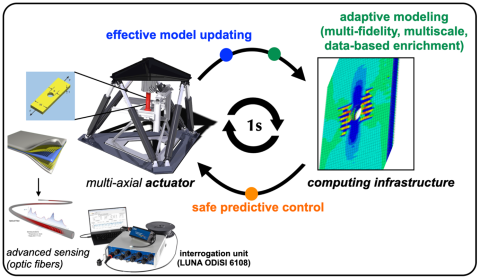
In the talk, I will present some effective numerical methods and tools developed, as part of a recent European (ERC) project, for the construction and use of such hybrid twins, accommodating real-time, accuracy and robustness issues. The focus will be on a novel sequential data assimilation framework (based on a modified dual Kalman filter) that continuously integrates sensor data into the numerical model, for damage detection, prediction, and control. I will detail the overall cross-disciplinary methodology which has been chosen, embracing computational mechanics with ROM and adaptive approaches, experimental mechanics based on distributed optic fiber sensing, data science including AI, as well as command synthesis with MPC. The performance of the proposed strategy will be illustrated on some selected engineering applications e.g, the online control of shaking table tests performed on large-scale damageable concrete buildings, and on the lab proof-of-concept specifically developed for the ERC project.
This project has received funding from the European Research Council (ERC) under the European Union’s Horizon 2020 research and innovation programme (grant agreement No. 101002857)
Biography:
Ludovic Chamoin is a Full Professor at Ecole Normale Supérieure Paris-Saclay, France, where he currently leads a research unit on advanced numerical methods for structural mechanics in the LMPS laboratory. His research activities span several topics of computational mechanics, including model verification/adaptation, multiscale analysis, model reduction, data assimilation, or uncertainty propagation, many of them implementing being based on interdisciplinary methodologies and collaborations with industry. He has co-authored more than 120 papers in international journals. He was selected as a Junior Member of Institut Universitaire de France (IUF) in 2019, then Senior Member in 2026, and has been the Principal Investigator of a European (ERC) research project dealing with real-time data assimilation for structural health monitoring since 2021. He also received several awards, including the John Argyris Award and the RJ Melosh Medal. Since 2026, he has served as President of the French Computational Structural Mechanics Association (CSMA).